Reimagining the Online Parts Shopping Experience
Background
Motorcycles invoke the idea of freedom, independence, and carefree fun. But they also require more regular maintenance than their 4-wheeled counterparts, and the burden of upkeep–including finding, purchasing, and installing parts–generally falls on the rider. While moto-mechanics have relied on RevZilla as a leader in motorcycle aftermarket parts since 2011, riders looking for Original Equipment Manufacturer (OEM) parts have to visit local dealerships or navigate clunky manufacturer sites to find important stock components. In 2018, RevZilla saw an opportunity to utilize the UX team to create a best-in-class online shopping experience for OEM parts.
My goal as lead researcher was to help the OEM team better understand the role of OEM parts in day-to-day life as a motorcyclist, and apply that insight to help design a user-friendly interface for a challenging, but necessary, aspect of motorcycle maintenance.
Approach
This project spanned 8 months of collaboration with a team including a UX designer, product manager, lead merchandiser, OEM parts specialist, and customer service leads. As lead researcher, I created a comprehensive plan that encompassed discovery, ideation, evaluation, and implementation of a new online parts shopping experience. We ran over 20 usability studies, surveyed 2,000+ shoppers, and interviewed dozens of employees and customers. Quantitative and qualitative research methods included:
- Internal interviews with stakeholders and experts to identify assumptions and business objectives;
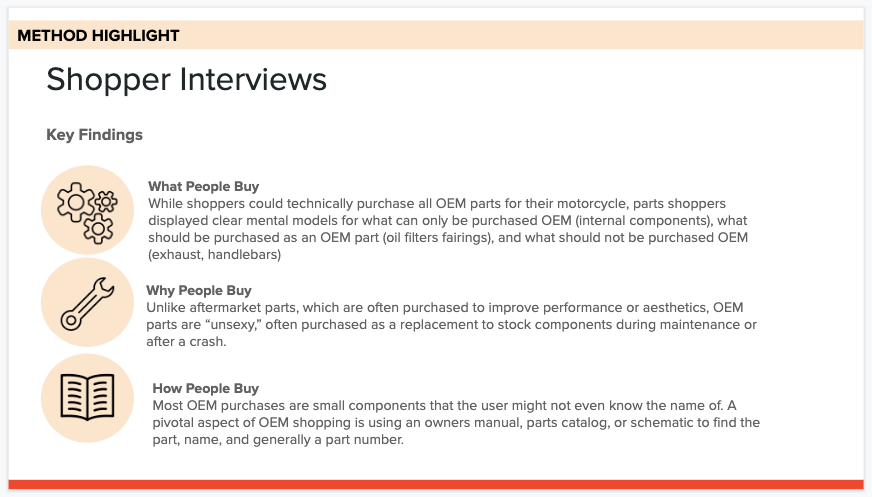
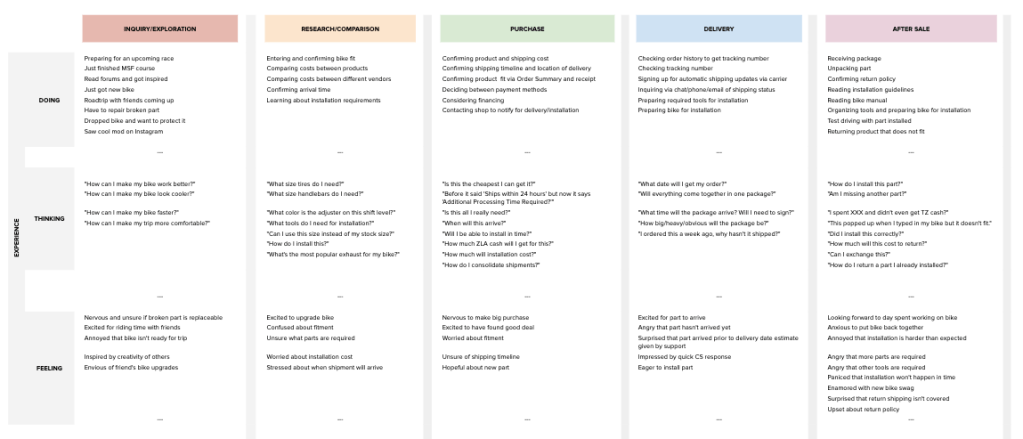
- Shopper interviews with employees and RevZilla customers to better understand the attitudes and perceptions around different types of parts shopping;
- UX heuristic evaluation to assess two competitor sites and create OEM-specific benchmarks and best practices;
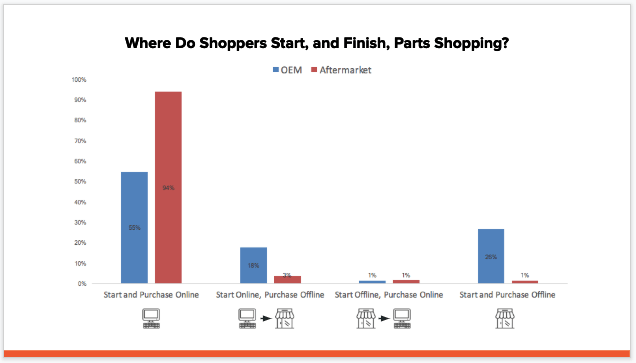
- Survey of current and potential parts shoppers to gain quantitative understanding of similarities and differences between OEM and aftermarket shopping experiences;
- On-site intercept surveys to gather in-situ customer feedback;
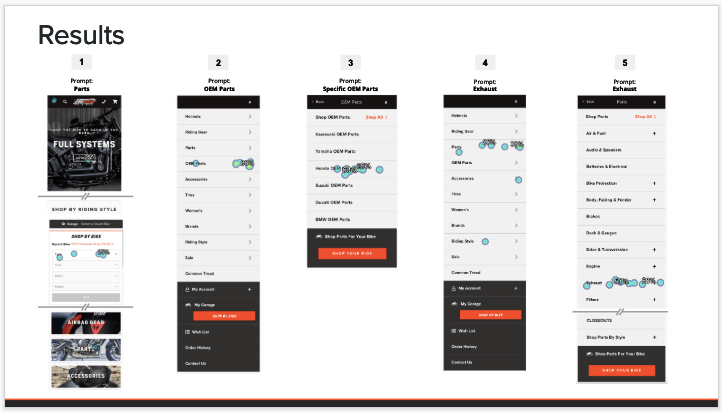
- First click tests to guide and evaluate navigation and taxonomy decisions;
- Unmoderated and moderated usability studies to assess task success, ease, and completion;
- Moderated shopalong studies to gain qualitative insight into current experience and future improvements
Key Findings & Impact
Finding #1: OEM and Aftermarket Parts are Interconnected
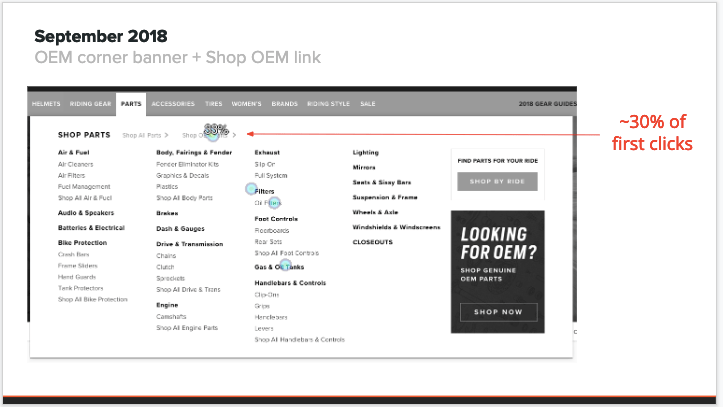
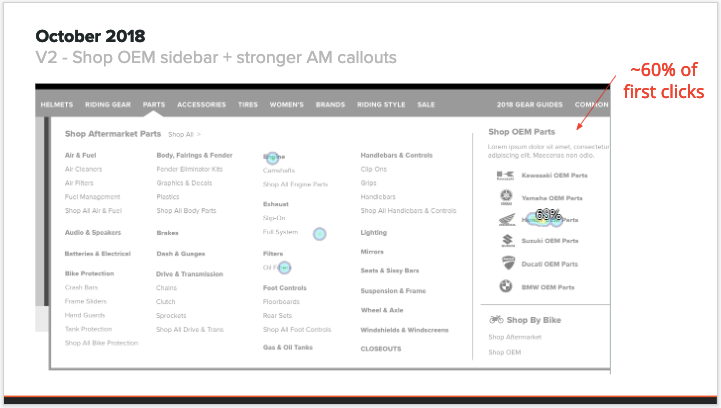
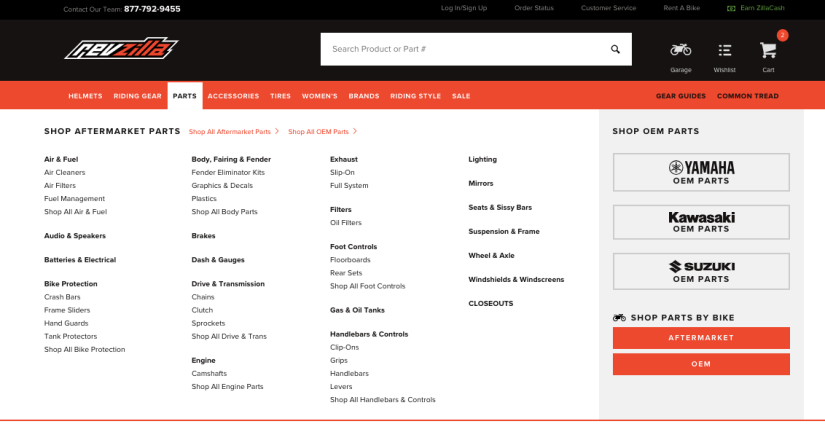
OEM shopping is distinctly different from aftermarket parts, from when shoppers buy to what shoppers buy. However, we also found that shoppers have a distinct mental model for OEM and Aftermarket parts: as sub-categories of a larger parts shopping umbrella. This meant that, although distinct, shoppers needed the ability to cross-shop and navigate between the two experiences seamlessly.
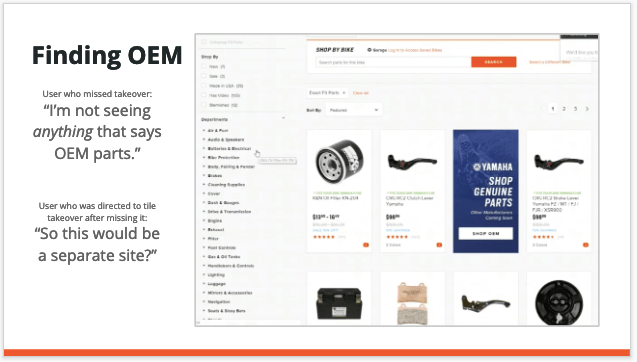
Impact: Understanding shopper mental models guided our decisions for navigation and taxonomy, including changes to our mega menu drawer, the main navigation header, as well as sub-navigation on category pages. It also led to the creation of a parts type toggle, allowing users to switch easily between OEM and Aftermarket parts and quickly identify, on every page level, their current path on the site.
Click the below thumbnails for details:
Finding #2: OEM Shopping is Visual
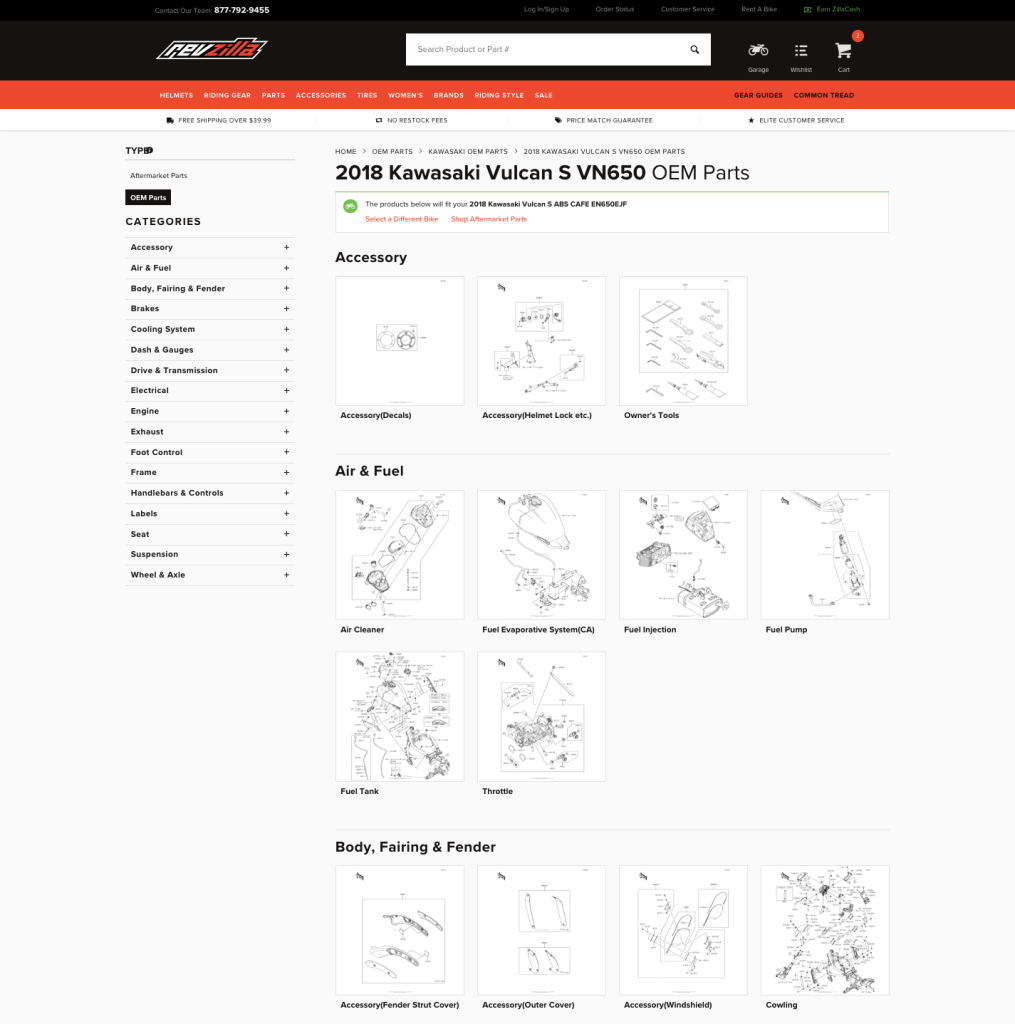
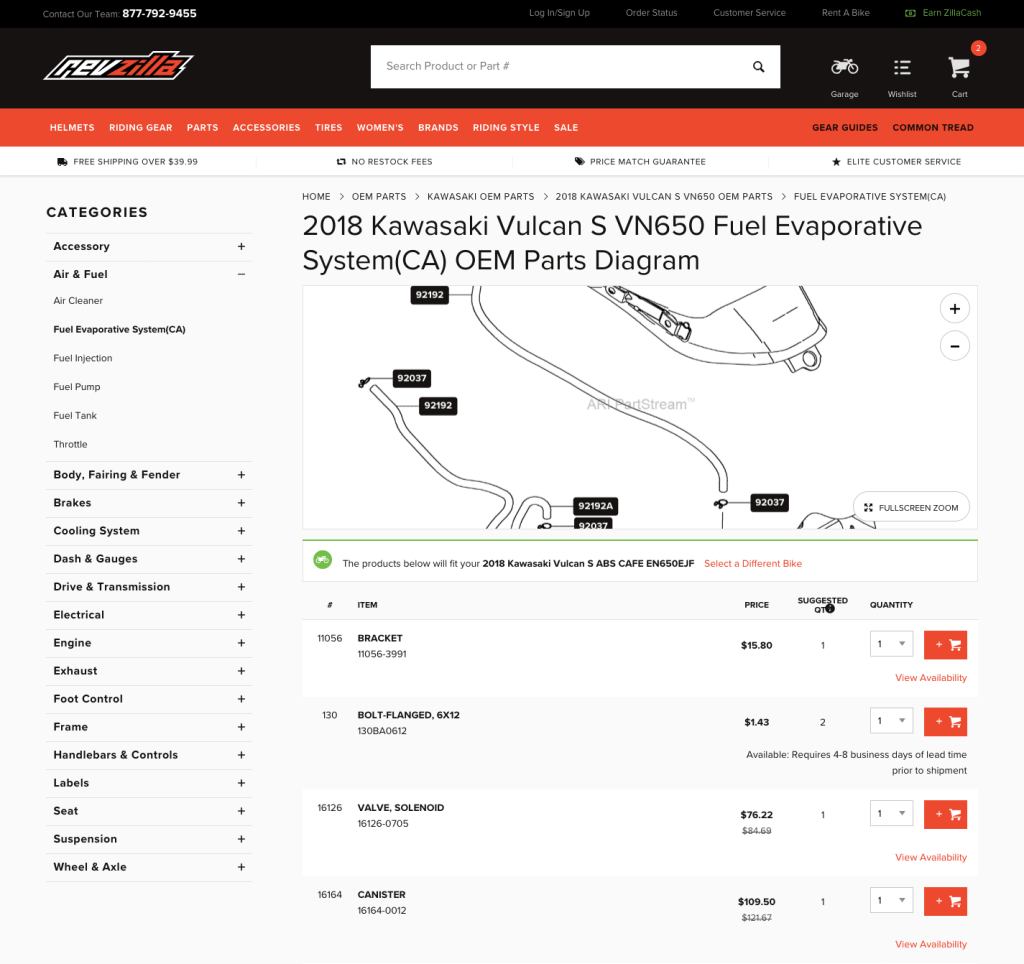
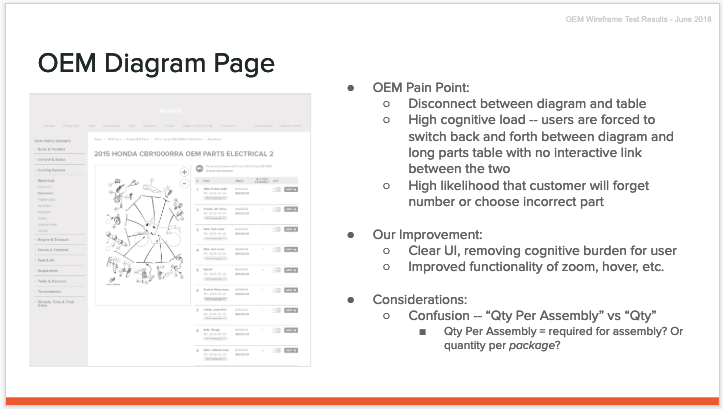
OEM purchases are generally small internal components needed to replace a stock part that is worn, broken, or missing (for example, a drain plug lost during an oil change, a snapped cable, a scraped fairing). This also means that shoppers rarely know the name of the part they are searching for, and rely on visual aids such as owner’s manuals, parts catalogs, and exploded diagrams to identify what to buy. Visual aids are also importance since manufacturers do not use a consistent taxonomy for grouping parts. Online, this means that shoppers have to bounce back and forth between obtuse category names like “Brake Caliper Two” and “Gasket Kit A” to find the component they are searching for.
Impact: Informed the design of a net-new page template for displaying OEM product categories as image thumbnails to allow shoppers to easily browse and pinpoint parts; led to the creation of a backend catalog system for restructuring manufacturer SKU information to build consistent front-end parts categories for shoppers. See thumbnails below for details.

Finding #3: OEM Shopping Requires Guidance and Help
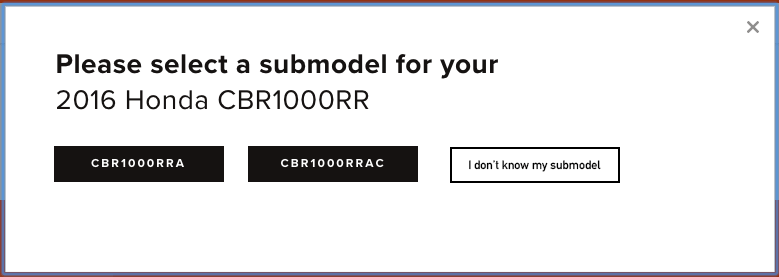
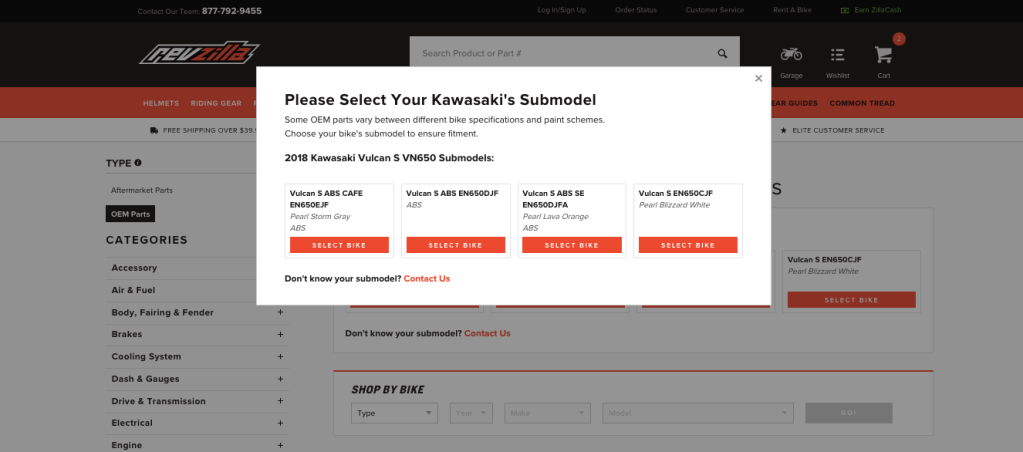
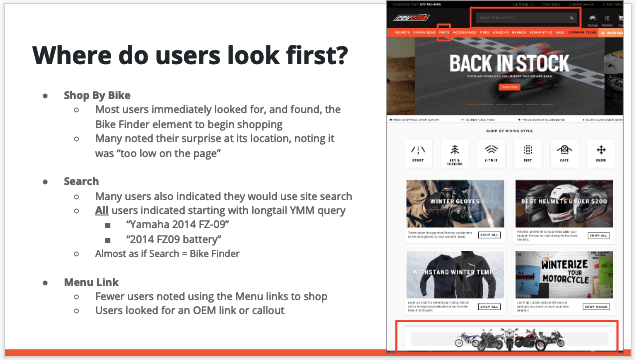
In both internal and external interviews, as well as our heuristic evaluation, we found that one of the most challenging aspects of OEM shopping is the requirement to select a motorcycle submodel prior to shopping. While most riders know their vehicle model (for example, a Honda CB500), OEM parts shopping online requires a user to select a very specific submodel of bike, represented by an obscure representation of numbers and letters that indicate anything from a vehicle’s fairing color to the country of origin. In our usability studies, we found this was a major source of friction for shoppers.
Impact: This finding led our catalog and BA team to partner in creating an extensive backend tool for automatically defining and “translating” submodel information into easy-to-understand titles. Now on RevZilla, instead of riders having to select between owning a Vulcan EN650EJF or a Vulcan EN650DJFA, they can simply select if their model is “storm gray” or “lava orange.”

Additional Materials


Notes
Special thanks to Michael Ennis (lead UX designer and creator of the above wireframes and page designs), Ryan Targoff (lead merchandiser), Hao Dong (OEM parts specialist), Peter Hitt (customer service team lead), and Joe Darrah (product manager) for the extensive partnership and support on this project.
 Lucy Gubbins